Dividing annual earning growth by volatility makes them Gaussian white noise

This work was done by my undergraduate student Ian Anderson, using the volatility data computed by my other undergraduate student Angel Piotrowski, see the previous post.

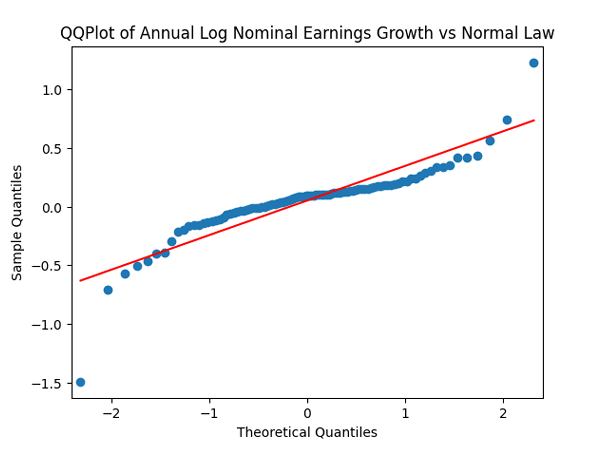
Ian took 1927-2023 net earnings of Standard & Poor 500 (since 1957; or its predecessor Standard & Poor 90)  E(t) and compute annual growth  G(t) = \ln(E(t)/E(t-1)). We do this first for nominal earnings, without adjustment for inflation. We analyze  G whether it is Gaussian independent identically distributed. We make the quantile-quantile (QQ) plot versus the normal distribution.

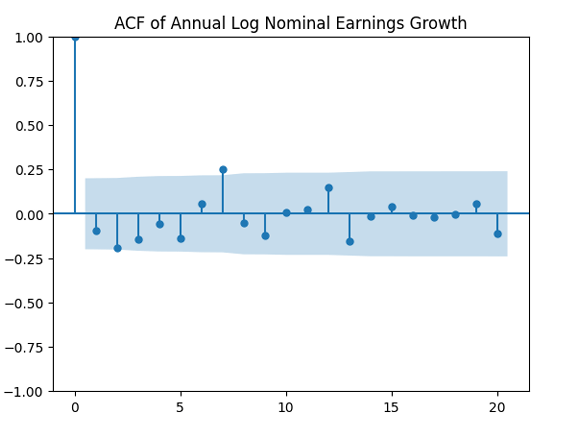
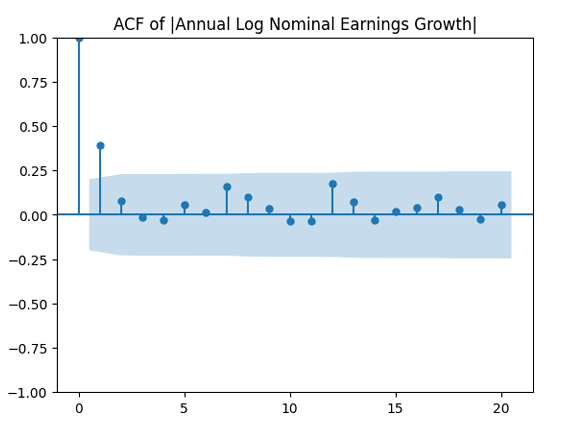
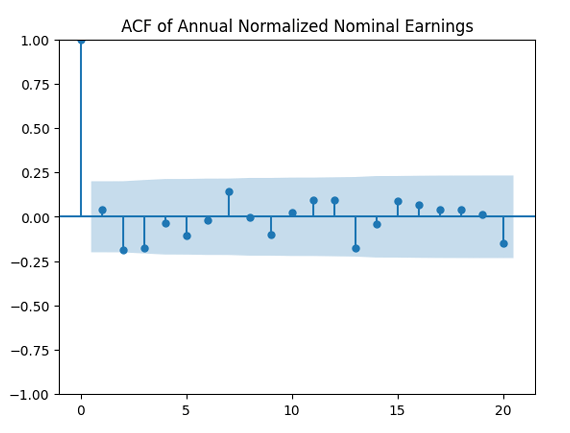
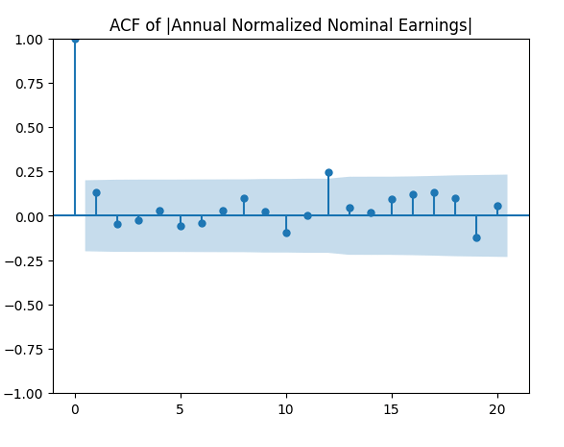
And we plot the autocorrelation function for  G and another plot for the autocorrelation function for  |G|.

We see from the QQ plot that, unfortunately, earnings growth terms are not Gaussian. The autocorrelation function for earnings growth corresponds to white noise: It shows that  G(t) and  G(t-k) are uncorrelated. But with absolute values, this is not true. There is a significant autocorrelation of lag 1:  \mathrm{corr}(|G(t)|, |G(t-1)|).

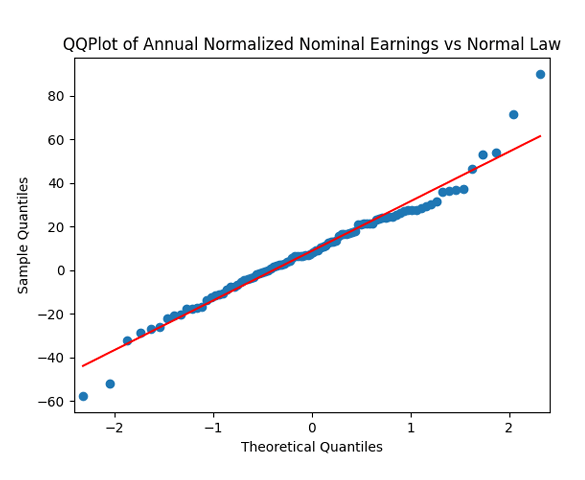
Then divide the earnings growth by annual volatility and get  G(t)/V(t). Does this division improve these terms to make them closer to Gaussian independent identically distributed? In fact, yes!

We see that now both autocorrelation plots show lack of significant autocorrelations. And the quantile-quantile plot is much closer to linear. Thus it makes sense to model  G(t)/V(t) as independent identically distributed Gaussian.

The same happens if we consider real earnings (inflation-adjusted) instead of nominal earnings, using December data for the Consumer Price Index. Thus we have joint model for earnings and volatility, annual 1927-2023:

 \ln V(t) = \alpha + \beta \ln V(t-1) + W(t)  \ln\frac{E(t)}{E(t-1)} = V(t)(Z(t) + g)

 (W(t), Z(t)) \sim \mathcal N_2([0, 0], \Sigma) are independent identically distributed bivariate normal, with mean zero and covariance 2×2 matrix  \Sigma This works for both nominal and real annual earnings, but not for dividends.

Published by


Responses

  1. Annual dividend growth terms does not become white noise after dividing by annual volatility – My Finance

    […] is the work by my undergraduate student Ian Anderson, continued from the previous post. He showed that annual earnings growth (nominal or real) are not Gaussian white noise. But after […]

    Like

  2. Earnings Growth/Volatility vs Rates and Spreads – My Finance

    […] his research on earnings growth from the previous post. In that research, Ian considers growth terms where are earnings during year These earnings […]

    Like

  3. S&P 500 Returns using Earnings Yield & Volatility – My Finance

    […] I extended it to two factors: annual volatility and annual earnings. Previously, annual earnings growth was modeled by another undergraduate student Ian Anderson. We have four […]

    Like

  4. S&P 500 Annual Returns with CAPE and Volatility – My Finance

    […] The equations from the previous post stay the same. We model earnings growth normalized by volatility for 1-year earnings. But for the returns, regression has trailing averaged earnings. The data are […]

    Like

  5. Growth/Volatility vs Spreads – My Finance

    […] of Ian Anderson, we model by dividing it by annual volatility Here, is annual (nominal or real) earnings of Standard & Poor 500 and its predecessor Standard & Poor 90. We regress it upon BAA-AAA and BAA-10YTR spreads […]

    Like

  6. Earnings Yield, 3 Bond Spreads, Annual Returns – My Finance

    […] Dividing annual earning growth by volatility makes them Gaussian white noise […]

    Like

  7. Valuation Measure and Long-Short Spread in the Simulator – My Finance

    […] will now use annual earnings of S&P for our research. This is important, since it connects stock returns with fundamentals. […]

    Like

  8. Simulator Final Update – My Finance

    […] updated the online simulator to include the bubble measure involving earnings growth, and the long-short spread. The previous version included only the BAA rate and stock volatility as […]

    Like

Leave a reply to Growth/Volatility vs Spreads – My Finance Cancel reply